
Spheres truly are amazing mathematical objects. I would consider them the most symmetrical of all objects, in any dimension (the ball, circle, and interval being other variations). There are problems, however, with incorporating spheres into our rigid Cartesian way of thinking, where only right angles are appreciated. This leads to such problems as the Mercator projection for maps, causing some young children to believe that Greenland is the size of Africa. It is an unfortunate fact that we cannot isometrically map the surface of a sphere to a plane, due to the very different nature of the two objects (most importantly their differing curvatures). Even in our use of spherical coordinates, we must introduce problems: the poles are ill-defined. I'm not just talking about the periodicity that comes into account any time we include an angular variable; I mean that an infinitude of values are possible for the azimuthal angle at the poles. As such, we see that there exist singularities of a sort at the north and south poles of a sphere in spherical coordinates. And singularities are always interesting.
I was reminded today of one method of mapping the sphere to the plane I came across at Berkeley: stereographic projection. The idea is illustrated below:
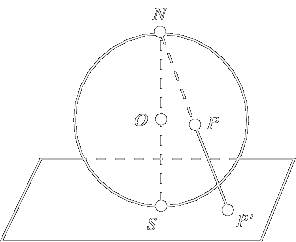
A sphere (usually unit radius for ease) is placed on a plane, so that its south pole and the origin of the plane coincide. A line from the north pole is drawn to any point on the plane, and we identify the point it intersects the sphere with the point on the plane (P with P'). This eliminates any problems with the south pole, but to what point is the north pole mapped? Once again, this one point is mapped to an infinite number of "ideal points" at infinity on the plane. What I find amazing is the way to fix that: compactify the sphere and the plane. This means we make one more point, called "infinity", that corresponds to the "edge" of the plane and the north pole of the sphere. In so doing, we create an conformal (angles are preserved) isomorphism between the sphere and the compactified plane (actually a homeomorphism). In this way, any problem that we need to do on the plane, like an integral or finding if lines are parallel or intersection properties, can be transformed to one on the sphere, which is often easier. For instance, all lines AND circles on the plane are just circles on the sphere (straight lines pass through the north pole). Parallel lines on the plane intersect at the north pole on the sphere. Integrals that cover the whole real axis are just over a circle on the sphere, etc. I think the mapping is neat because it relates in a very clear way two very different representations of the same object (the compactified plane).