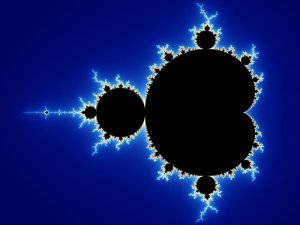
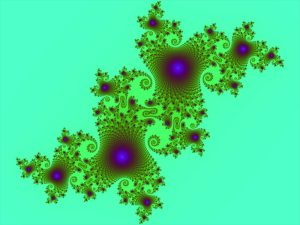
In my previous post, I described spheres as being the most symmetric of all objects. Well, a fractal is practically the opposite, though still with a degree of cohesiveness. Loosely speaking, a fractal is a set of points in space that is infinitely self similar, created through a non-terminating recursive iteration. In other words, if you "zoom in" on any section of a fractal, you see a similar pattern as the fractal on the whole. For example, broccoli has this property (to a point): each little clipping of broccoli looks like a miniature head of broccoli. Clouds, lightening bolts, coastlines and snowflakes have this property as well. It should be noted, however, that fractals also have a Hausdorff dimension that is greater than their topological dimension, ie, they are really jagged and convoluted. A Euclidean line is self-similar (you zoom in on a line and it looks like a line), but its geometry is entirely representable in Euclidean terms (both the Hausdorff and topological dimensions are 1). Fractals usually have fractional dimension. For example, the Sierpinski carpet shown below, created by removing the middle ninth of a square, then removing the middle ninth of each of the surrounding eight squares, and so on, has a dimension of 1.8928.

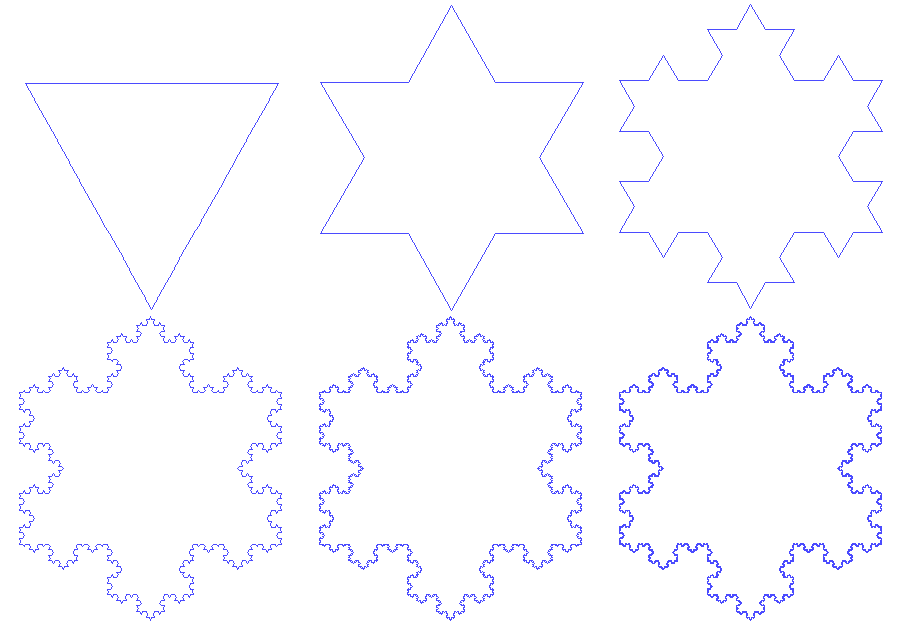
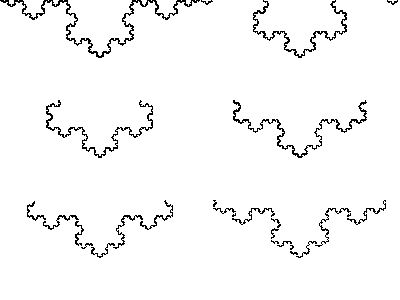
It's almost 2 (an area), but a bit lower (towards 1, a line). Even though the square started as a 2 dimensional area, an infinite number of removals actually lowers its dimensionality. Another example is the Koch snowflake, below, with a dimensionality of 1.26. Thus it's mostly a 1-D curve, but is "dense" enough that it almost fills a bit of area. On zooming in on one corner, we see the same structure repeated indefinitely.
Real objects, of course, are not true fractals, in that if you zoom in enough the self-similarity breaks down, and we notice that a broccoli cell does not look like a head of broccoli. Fractal behavior can come into play when considering the real-world phase spaces of chaotic systems. Chaotic systems are inherently fractal, in that there is no long-term cyclic behavior, so that paths in the phase space of a chaotic particle never cross, but also never return to the same path or approach a single point/curve. As such, the paths "fill" regions of phase space, in some cases densely, so that it really is 2 dimensional, and in some cases more like a line, yielding a fractal dimension. Graphical representations of certain iterative functions can yield striking patterns like the Mandelbrot and Julia sets, again possessing detail at arbitrary scales.