
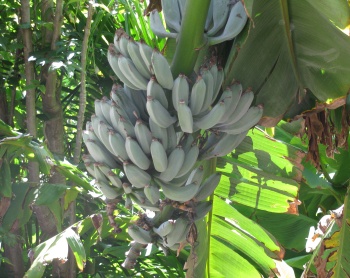
Bananas are truly amazing plants, and an entire botany course could be devoted to them. They are the largest herbaceous flowering plants (at the end of the growing season, the leaves and stems die down to soil level) in the world, and at up to 25 feet tall, are often mistaken for trees. The "trunk", however, is actually a pseudostem composed of compressed leaves, and the true hardened part of the plant is a corm: a short, underground storage organ used by the plant in adverse times. The large leaves can grow up to 9 feet long, and are used by many people as roofing, umbrellas, or other building materials in their countries of origin.
Monocots; Commelinids; Zingerberales; Musaceae; Musa acuminata
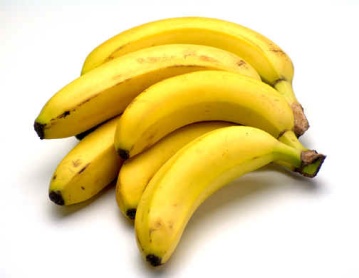
The plants are monoecious, meaning an individual has both male and female reproductive units (flowers). Among plants, this is quite common, of course. In bananas, however, there is an enormous morphological difference between them: the male flower is sterile and is called the "banana heart", which is eaten as a vegetable in Southeast Asia, and resembles a pointy eggplant at the end of the stem; the female flowers are produced in bunches farther up the stem and produce the epigynous berries we eat without requiring fertilization. In cultivated varieties, the seeds have degenerated to tiny black specks.
Bananas have their origin in Southeast Asia, and have been cultivated there for at least 7000 years. Its spread throughout Africa seems to have been facilitated by the expansion of Islam. Indeed, our word "banana" comes from the Arabic word banan, meaning "finger". It is possible that Linnaeus gave the genus its name, Musa, after the Arabic word for banana, mauz. In colonial times, banana plantations began forming the basis of large commercial empires, culminating in the "banana republics" of Central and South America, wherein dictatorships led by a small, wealthy, corrupt government exploit the agricultural resources of the country at the expense of the rest of the population, modeled after colonial Spanish rule.