
Instead of this post being about a specific plant, I'd like to discuss members of the subfamily Prunoideae (somtimes called Amygdaloideae). The group is a relatively advanced one, belonging to the family Rosaceae, and containing about 500 species. One of the distinguishing characteristics of the group is the presence of drupes, or stone fruits, as the fruiting bodies, so called because the edible pericarp surrounds a hardened shell around the seed. This "stone" or "pit" is usually inedible (except for almonds), and contains high quantities of hydrogen cyanide, giving it a bitter taste (in bitter almonds, the concentration can actually be deadly). The flowers are usually white or pink, with five petals and five sepals (green lobes behind petals in the flower). The picture below was taken at the Quail Botanical Gardens subtropical fruit section.
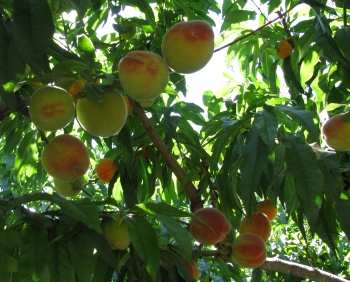
Eudicots; Rosids; Rosales; Rosaceae; Prunus persica
Some of the better known Prunoids are almonds, peaches (nectarines being a smooth cultivar), plums, apricots, and cherries. Note that almonds are not a true nut in that the fruit is not a hardened ovary, but rather a drupe. All members are deciduous trees, and trace their origin to China and the Far East. Extensive hybridization had produced many cultivars, and all of them are delicious.