
The kiwifruit, or kiwi, is native to southern China, but has primarily been exported by New Zealand since the 1950's. In fact, the name itself comes from the berry's similarity to the kiwi bird of New Zealand. The Chinese have adopted the kiwi as the national fruit of China in an effort to remind the public of the fruit's origin. The plant is a woody vine of the order Ericales, a rather diverse group of asterids including blueberries, tea, pitcher plants, persimmons, and azaleas. Common cultivars produce an oval berry, with fibrous brown skin and bright green flesh, with rows of small edible black seeds. The flavor is sweet and tart, rather unique, and almost citrus-like.
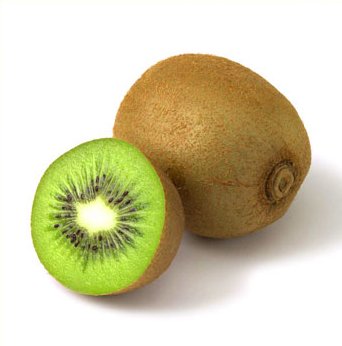
Eudicots; Asterids; Ericales; Actinidiaceae; Actinidia deliciosa
The fruit is rich in vitamin C and potassium, and serves as a natural blood thinner. The skin is very high in dietary fiber, and as such the fruit can be a mild laxative, though the skin is usually not consumed. It is also rich in the enzyme actinidin (same family of thiol proteases as papain), to which some people can have allergic reactions. The fruit also conatins calcium oxalate (read my starfruit entry). Thus the raw fruit should not be used in dishes containing milk or dairy products, or gelatin, as the enzymes dissolve collagen and casein. I found this out the hard way during a high school biology project, in which we attempted to make a food model of the cell. A hollowed watermelon served as the cell wall, and whole kiwis were used as chloroplasts. The cytosol, unfortunately, was chosen to be lime jello, and the kiwi proteases dissolved the jello overnight, resulting in a soup of sugary, sticky organelles the next day. I could never hold it against the kiwis, though...they are far too delicious, as the species name implies.