
Since I missed last week, I suppose I'll do a second one today. Sometimes I'll just take seed of stuff I buy at the market and save them for planting once we eat them. A while ago I did this with the seed of a honeydew melon, and lo-and-behold, it took off and started producing a melon. It's small and a bit misshapen right now, but perhaps someday we'll be able to eat it. Now, the melon family Cucurbitaceae is a large one, and also includes cucumbers, squashes, and gourds. It is one of the oldest groups of cultivated plants in both the New and Old Worlds, and it's easy to see why they are so useful. In addition to a nice, easy to eat, soft, pulpy flesh, you get a storage container free of charge. It's waterproof, easy to decorate, and lasts for a long time with minimal curing investment. Being a vine, they are also fairly easy to grow. The fruit is a type of epigynous berry called a pepo.
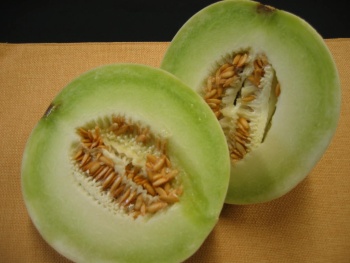
Eudicots; Cucurbitales; Cucurbitaceae; Cucumis melo
The honeydew is actually a cultivar of the muskmelon Cucumis melo, which is native to northwestern India. Other cultivars include the Crenshaw melon and the cantaloupe. The species is divided into 8 cultivar groups, with the honeydew belonging to the Inodorus Group. We know it best as a sweet melon with a pale green or orange flesh and medium-sized whitish seeds, great for breakfast or desserts.