
Prompted in part by Rachael's entry on bilirubin, as well as a subsequent discussion on metabolism (Phil, this is an implicit request for an entry on ureotelism vs. uricotelism...), I've decided to write a little bit about bilins as a chemical compound, and refer you to my page on colored molecules for additional information.
Bilins are the byproduct of the anabolism of porphyrin rings. Porphyrins are cyclic tetrapyrroles (a pyrrole molecule is shown below), in that four pyrrole rings are covalently linked into a ring structure.
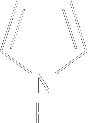
Pyrrole
Porphyrins, and tetrapyrroles in general (cyclic or linear), are very common biochemical motifs in life; notable examples are chlorophyll and heme (below). Tetrapyrroles are extensively conjugated, to the point that energy level differences are in the optical range. Hence, most are colored, and with the addition of coordinated ions (Mg in chlorophyll, Fe in heme), the colors can extend through the optical range. Heme is a reddish color (absorbing in the green), giving meat and blood the red color we are familiar with. Chlorophyll, in addition to being colored, actually transfers absorbed quanta of blue and red light to the photosystems, from which plants extract energy.
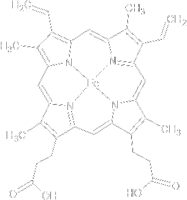
Heme
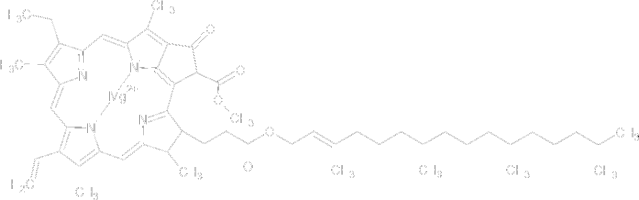
Chlorophyll a
At any rate, when organisms metabolize porphyrins and break them down, one of the first stages of byproduct are bilins, which are linear tetrapyrroles. Breakdown of heme results in bilirubin (below), while chlorophyll breakdown produces phycobilins (which are also used as accessory pigments to capture other wavelengths). Bilirubin is a yellowish color (no coordinated iron, and a different delocalization of electrons), which is why our urine is yellow in color.
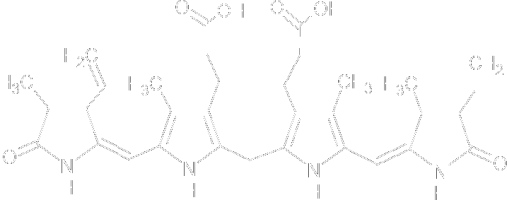
Bilirubin
For people with liver problems, heme breakdown is not carried out completely, resulting in an accumulation of bilirubin. This is called jaundice, and gives the skin and eyes a yellow color. This is also the cause of yellowish patches around bruises. In infants, liver complications are common, and elevated bilirubin levels are diminished by phototherapy: as a pigment, bilirubin undergoes a slight conformational change upon light absorption (it absorbs most in the violet/blue region). This conformational change makes the isomer more soluble, thus easier to excrete.